
Association Congress 2026: Why Digitalization Alone Is Not Enough
At the 20th German Association Congress in Bonn, one term took center stage: relevance. Whether internally, externally, or for members—an aspiration that initially seems to have little to do with technology. And yet, the path leads there very quickly.
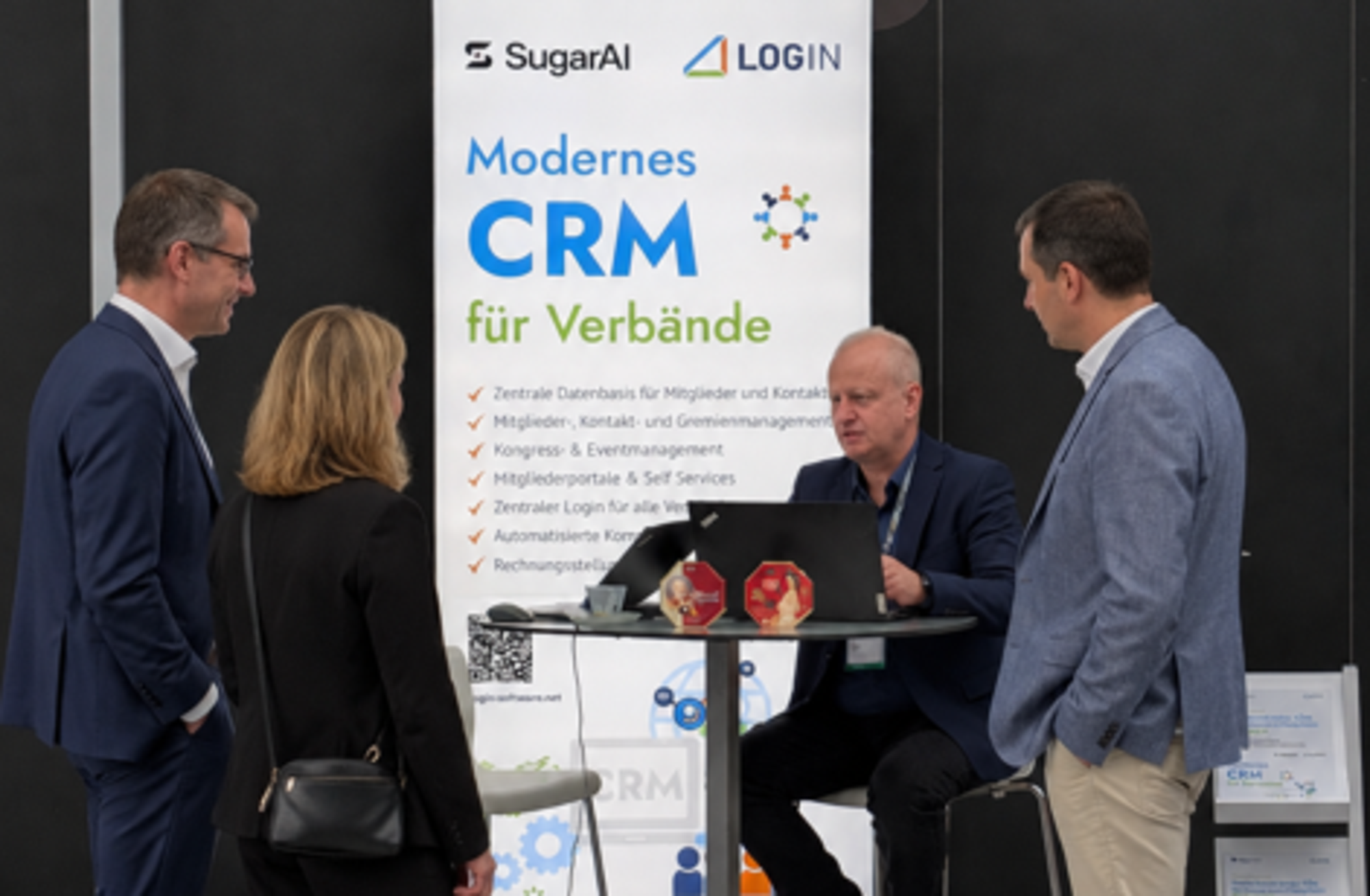
Representing Login, Michael Ruzek and Frank Tjaben were on site, using the two days of the congress to gain first-hand insights into current developments in the association world and to exchange ideas with attendees and industry representatives. What was particularly exciting was looking at the issues currently driving associations—and the role that digitalization and new technologies can play in addressing them.
After all, digitalization, AI, and new technologies ranked high among the current challenges facing associations. At the same time, discussions centered on communication and visibility, strengthening member networks, clear positioning, and delivering tangible added value to members.
This shows that digitalization is no longer viewed in isolation as merely an IT project. It is meant to help associations perform their core missions more effectively.
Member orientation requires more than a member database
Anyone looking to address members more individually, develop relevant offerings, and strengthen relationships over the long term must first know who they are actually dealing with.
In many associations, the necessary information already exists, but it is scattered across different systems. Member data lives in administration, event details in an event tool, newsletter metrics in a marketing solution, and additional contacts perhaps in Excel spreadsheets or personal email inboxes. Thus, the problem is often not a lack of data—it is the absence of a unified view.
This is precisely where the role of a modern CRM system is evolving. It is not just about managing contact details. Rather, it creates a single, central view of members, prospective members, committees, partners, sponsors, event attendees, and other key relationships relevant to the association.
AI makes a solid database even more critical
Hardly any digital topic is currently being discussed as intensively as artificial intelligence, and it played an appropriately prominent role at the Association Congress. For associations, numerous opportunities are opening up: finding information faster, drafting communications, supporting processes, or making existing knowledge more accessible. Yet AI does not solve one fundamental issue: it cannot simply compensate for missing structures and poor data quality.
The more AI integrates into daily operations, the more critical the question becomes: what information base is it working from? Is the data up to date? Is information interconnected? Is it clear which data may be used? And is relevant information available centrally in the first place?
Consequently, the meaningful use of AI often begins not with selecting an AI tool, but with data quality, processes, and system architecture.
The association office of the future needs fewer system silos
Member administration, events, newsletters, invoicing, portals, certifications, committee work: numerous processes converge within associations. If new standalone solutions are continuously introduced to handle them, a digital landscape quickly emerges that, while made up of many good tools, still complicates day-to-day work.
The decisive question is therefore not how to digitalize as many processes as possible, but rather: how can they be connected meaningfully? A member registers for an event, attends a course, earns a certificate, or assumes a committee role. Such information should not exist in isolated silos. Only when brought together does a complete picture emerge—laying the groundwork for better services, more targeted communication, and more efficient operations.
Relevance is not created by technology
Perhaps this is one of the most important takeaways we at Login brought back from this year's Association Congress: the challenges associations face are not primarily technical in nature. Instead, they revolve around member retention, visibility, added value, efficient head offices, and the ability to evolve. Digitalization, CRM, and AI are not ends in themselves; they are tools.
When used correctly, however, they ensure that staff spend less time on manual workflows and searching for information—and more time on what truly matters in an association: people, relationships, and substance.
Looking to drive the digital transformation of your association? Contact our experts for a non-binding initial consultation.

Yours Frank Tjaben
Leiter Vertrieb
frank.tjaben@login-software.net
+49 89 2020447 25
 login-software.net